


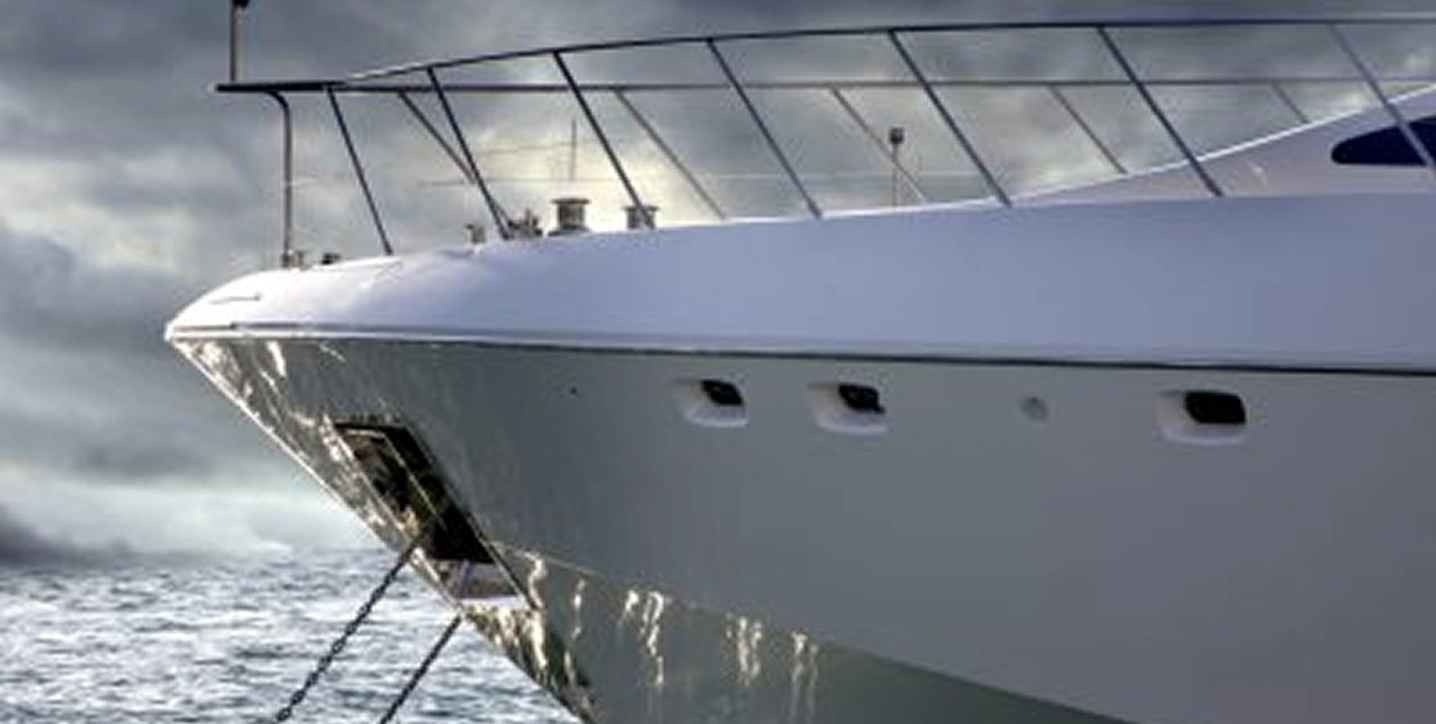
Anchoring is one of the most routine operations undertaken on board a yacht. It is also one of the least visible.
Once the anchor disappears below the water surface, crews have traditionally had to assess what is happening indirectly, through vessel movement, weather conditions, position data, experience and judgement.
That gap between what is happening at the anchor and what can be seen from the vessel was the starting point for our six-part series on anchoring and operational risk.
Across the series, we looked at anchoring from several different perspectives: the experience of professional captains, data from the AnchorGuardian Captain Survey, and the claims and insurance perspective provided by Pantaenius.
Taken together, they reveal a more complex picture of anchoring risk than claims statistics alone might suggest.
Claims tell only part of the story
Serious anchoring claims are relatively uncommon when viewed against the overall number of yacht insurance claims.
That does not mean anchoring incidents are rare.
Captain survey data shows that anchor dragging and near misses are a familiar part of professional yacht operations. Many incidents are resolved by the crew before damage occurs and therefore never become insurance claims.
Others may ultimately be recorded under categories such as grounding, collision or machinery damage rather than as anchoring incidents.
The result is an important distinction:
Claims data shows us where anchoring risk resulted in loss. Operational experience shows us how often crews may have had to prevent that loss from occurring.
Understanding both perspectives gives a more complete picture.
Near misses matter
One of the strongest themes to emerge from the series was the importance of near misses.
A captain who identifies developing anchor movement early and successfully recovers the situation has done exactly what good seamanship requires. From an insurance perspective, there may be nothing to record.
From a risk-management perspective, however, the event still contains valuable information.
What conditions were present? How quickly did the situation develop? What indications were available to the crew? How much time did they have to respond?
Near misses can tell us where risk exists before it becomes a claim.
That makes them an important part of the wider conversation around safer anchoring.
Anchor drag does not always look like anchor drag
Another recurring theme was that a developing anchoring problem may not initially present itself in an obvious way.
Changes in wind, current, vessel loading and surrounding traffic can all influence how a yacht behaves at anchor.
The vessel itself is constantly moving.
This means detecting anchor movement is not always as simple as observing a yacht moving outside an expected position.
The operational challenge is therefore not only knowing that the vessel has moved, but understanding why it has moved and what is happening below the water surface.
That distinction becomes particularly important when crews are deciding whether a situation requires immediate intervention.
Better information also improves what happens afterwards
The value of anchoring information does not end once an incident has been resolved.
Where damage does occur, reconstructing events can be difficult.
Captains, owners, managers, insurers and investigators may need to understand what happened, when it happened and how quickly the situation developed.
Was the anchor holding initially? Did movement begin gradually or suddenly? Were environmental conditions changing? What actions were taken by the crew?
The more objective information available, the easier it becomes to establish a reliable sequence of events.
This is increasingly relevant in a maritime environment where evidence, documentation and operational transparency are becoming an important part of risk management.
Environmental consequences are becoming harder to ignore
Anchoring risk is also no longer limited to the yacht itself.
Damage to seabed habitats, subsea cables, pipelines and other underwater infrastructure can create environmental, financial and reputational consequences far beyond the immediate vessel.
At the same time, anchoring restrictions across the Mediterranean are becoming more detailed as authorities seek to protect sensitive seabed areas.
For captains, this adds another layer to anchoring decisions.
Where is the anchor positioned? What is happening on the seabed? Is the yacht remaining safely within the intended anchoring area?
The environmental dimension makes greater visibility around anchoring increasingly relevant not only for vessel safety, but also for responsible yacht operation.
The wider shift is towards operational visibility
Perhaps the most important conclusion from the entire series is that anchoring is beginning to join a wider development already visible across professional yachting.
Navigation, weather routing, machinery monitoring and bridge systems have progressively provided crews with better information on which to base decisions.
Anchoring has historically remained comparatively dependent on indirect information.
That is beginning to change.
The discussion is therefore larger than any single piece of equipment or technology. It is about whether more information can help crews identify developing problems earlier, understand situations more clearly and make better-informed decisions.
For insurers, it can mean stronger risk management and better evidence.
For owners and managers, it can mean greater operational visibility.
For captains, perhaps most importantly, it can mean more time and better information when deciding what to do next.
Bringing the perspectives together
No single dataset tells the complete story of anchoring risk.
Claims data identifies losses.
Captain experience reveals the operational events that may never become claims.
Near-miss information highlights situations where crews successfully intervene.
Environmental developments introduce new responsibilities.
And better operational data can improve both decision-making on board and understanding after an incident.
Looking at these perspectives together changes the conversation.
Anchoring should not be viewed only as a traditional seamanship task or as an occasional source of insurance claims. It is part of the broader operational risk environment of a yacht.
And as professional yachting continues to move towards greater evidence, visibility and informed decision-making, anchoring is increasingly becoming part of that same conversation.
This article summarises the key findings from AnchorGuardian’s six-part series on anchoring and operational risk in professional yachting:
Read the full Operational Risk Series
Article 1: What Do We Actually Know About Anchoring Risk?
Article 2: The Near-Miss Data Nobody Sees
Article 3: When Anchor Drag Doesn’t Look Like Anchor Drag
Article 4: What Actually Happened?
Article 5: Environmental Liability at Anchor
Article 6: What Every Owner Should Know About Anchoring Risk
Shout out to Hugh Whyte for the photo. Thanks Hugh.
Photo by Hugh Whyte on Unsplash
